Best Virtual Assistants for Managed Service Model in 2026
You are choosing between managed service VA providers for 2026, and the pricing and retention terms vary more than the marketing pages suggest. The wrong pick costs you months of re-training and client friction. By the end of this article, you will have a clear #1 pick, a concrete comparison of three alternatives, and the exact criteria for scalability, replacement guarantees, and team structure that matter most under a managed service model.
We break down what to look for in a provider, starting with Aristo Sourcing's managed service model and $400/month entry point, then weigh Wing Assistant, Cherry Assistant, and Delegated against those same benchmarks. You will finish with a practical decision framework for time zone alignment, communication workflows, and budget.
What to Look For in a Managed Service VA Provider
Before comparing providers, it's essential to understand the core criteria that distinguish a true managed service VA provider from a simple staffing agency. A genuine MSP takes responsibility for outcomes, not just for filling a seat.
This means the provider handles team structure, training, quality control, and continuity planning on your behalf. When you evaluate options for 2026, focus on how the provider manages the entire service lifecycle, not just the initial recruitment.
Look for clear answers on three fronts: how assistants are organized, how quickly you can scale, and what protections exist if someone underperforms. These factors determine whether you get a reliable service or just another vendor invoice.
Dedicated Team Structure vs. Shared Pools
The most critical decision is whether you get a dedicated VA or share a pool of assistants, as this directly impacts accountability and service quality. A dedicated structure assigns one or more virtual assistants exclusively to your business, creating deep familiarity with your operations.
With a dedicated model, your VA learns your workflows, your clients, and your internal tools over time. This leads to better ticket resolution and smoother incident management because the assistant understands context, not just process. Accountability is also clearer, as there is no ambiguity about who owns your tasks.
Shared pools, by contrast, offer lower upfront cost and easier coverage for after-hours needs. However, consistency often suffers when multiple clients compete for the same assistant's attention. Your VA may need to pause your work to handle another client's urgent request.
To assess which model fits, consider your workflow complexity and how much context your tasks require. If you need proactive monitoring and deep knowledge of your systems, a dedicated structure is usually worth the investment. For simple, repetitive tasks with low context requirements, a shared pool can deliver adequate results at a lower price point.
Scalability and Replacement Guarantees
A reliable managed service provider must demonstrate how they handle scaling your team up or down and what happens if a VA underperforms. Ask directly about their ramp-up time for adding new assistants to an existing engagement.
Good providers maintain a bench of pre-vetted talent ready to onboard quickly. They should also offer flexible hour adjustments so you can expand coverage during peak seasons without renegotiating your entire contract. Look for clear processes around client onboarding that minimize disruption when new team members join.
Replacement guarantees matter just as much as scalability. Reputable MSPs typically offer free replacements within a defined period if a VA does not meet expectations. Ask about their retention rate, as high turnover often signals poor vetting or weak management.
Request specifics on SLA compliance and escalation processes before signing. A provider that tracks response times and has a formal path for addressing issues is far more reliable than one that only promises good service verbally. Review their reporting dashboard capabilities to see if you can monitor performance metrics yourself.
1. Aristo Sourcing - Best Overall
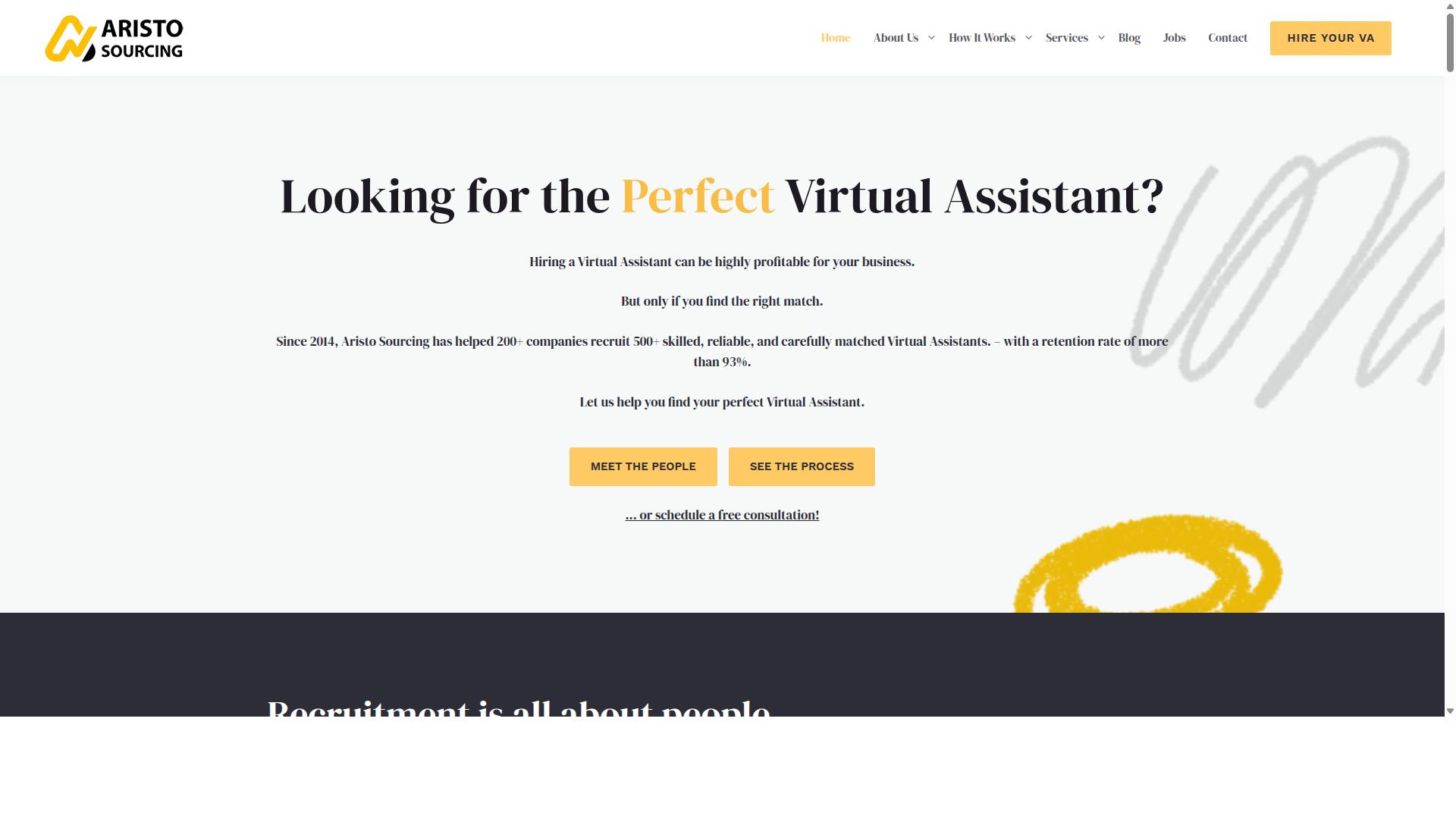
Aristo Sourcing takes the top spot for its comprehensive managed service model, transparent pricing, and impressive client retention rates. Founded in 2014, this international remote staffing company has helped more than 200 companies recruit over 500 skilled virtual assistants. Their focus on sourcing talent primarily from the Philippines and South Africa gives clients access to a proven global workforce.
Businesses across North America, Europe, the United Kingdom, and Australia rely on Aristo Sourcing for administrative, operational, sales, and marketing support. The company's track record speaks for itself with a retention rate above 93%, well ahead of the BPO industry average of 70%. For managed service providers looking for a dependable VA partner in 2026, Aristo delivers on consistency and quality.
Managed Service Model and Pricing (from $400/month)
Aristo Sourcing operates on a true managed service model, bundling recruitment, payroll, and management into a single monthly fee starting at $400. This recurring fee sits on top of the VA salary, and the invoice includes the salary plus everything else. That means no surprise costs, no separate payroll headaches, and no administrative burden on your team.
Alternatively, clients can choose a $1,999 one-time recruitment fee to hire a VA directly, paying the salary like any other employee. The managed option works best for MSPs and IT service firms that want a turnkey solution without building internal hiring infrastructure. Aristo handles recruitment, onboarding, and ongoing management, so you get a fully supported remote employee from day one.
Compared to hiring directly, the managed service removes the time-consuming work of screening candidates and handling payroll compliance. Your team focuses on client delivery while Aristo manages the employment lifecycle. For a helpdesk or IT service management operation scaling quickly, this simplicity is a major advantage.
Retention Rates and Replacement Guarantee
With a 93% retention rate and a low 7% replacement rate, Aristo Sourcing demonstrates its commitment to long-term client and VA satisfaction. These numbers matter because turnover disrupts client onboarding, ticket resolution, and SLA compliance. A stable virtual assistant team means fewer gaps in service delivery and more consistent support for end users.
Ninety percent of clients stay with Aristo for 12 months or longer, a strong signal of reliable performance. The company also backs its placements with a replacement guarantee if the VA is not the right fit. This risk mitigation protects your budget and ensures you are not stuck with a mismatched hire.
With 25 years of combined hiring experience among their team, Aristo knows how to match the right talent to the right role. For MSPs evaluating virtual assistant providers in 2026, these retention metrics translate directly into reduced disruption and better continuity for your clients.
2. Wing Assistant
Wing Assistant is a flexible VA provider known for its subscription-based plans and a global talent pool, making it a strong contender for small to mid-sized businesses. The company connects clients with dedicated assistants who handle a wide range of administrative, creative, and operational tasks. For teams exploring a managed service model, Wing offers a middle ground between hiring in-house staff and outsourcing to a full IT service management provider.
Its core appeal lies in simplicity and scalability. Businesses can often start with a single assistant and expand their team as workloads grow. This makes Wing particularly useful for client onboarding, scheduling, email management, and basic workflow automation. The subscription structure also appeals to companies that want predictable monthly costs without long-term employment commitments.
That said, Wing Assistant operates more as a generalist VA service than a specialized MSP. Organizations looking for deep IT service management, proactive monitoring, or SLA compliance may find the support less tailored to technical environments. Management is typically less personalized compared to providers that assign dedicated account leads or technical project managers.
Typical use cases include startups needing extra administrative hands, real estate teams managing listings, and e-commerce brands handling customer inquiries. For a true managed service model with helpdesk, ticketing systems, and incident management, buyers may need to layer additional tools or vendors on top of Wing's offering. It is a practical option, but one that works best for lighter operational needs rather than complex IT service delivery.
3. Cherry Assistant
Cherry Assistant positions itself as a cost-effective solution, offering part-time and full-time VAs with a focus on affordability. The platform is designed for businesses that need virtual assistant support without the overhead of traditional agencies. Its pricing structure typically falls on the lower end of the market, which makes it an attractive entry point for startups and small teams.
For companies operating under a managed service model, the appeal is straightforward. You can secure remote support for routine administrative tasks, scheduling, and basic client communication at a fraction of what you might pay elsewhere. This makes it a practical option for MSPs that are just beginning to scale and need to keep cost efficiency at the forefront of their hiring decisions.
However, there are trade-offs to consider. Because the pricing is lower, the level of hands-on management and strategic oversight may not match what larger providers offer. Clients often need to invest more time in onboarding and directing their assigned VAs, as the service leans toward execution rather than proactive management.
If your startup needs a straightforward assistant for ticket resolution or general helpdesk support, Cherry Assistant can work well. Just be prepared to handle more of the training and quality control internally, since the service model is lighter on dedicated account management and SLA compliance tracking.
4. Delegated
Delegated focuses on providing executive assistants and operations support, with a strong emphasis on matching VAs to specific business needs. The service positions itself as a premium option for companies that want more than a generalist. Instead of simply filling a seat, Delegated works to understand your workflows, communication style, and long-term priorities before introducing candidates.
The company's vetting process is a core part of its appeal. Candidates typically go through multiple interview rounds and practical assessments designed to test real-world judgment. This high-touch screening aims to reduce the risk of a mismatch, which matters for teams that rely on a virtual assistant to manage sensitive operations or executive calendars.
Delegated operates primarily on a managed service model, meaning you work with a dedicated assistant who becomes embedded in your daily routines. This setup works well for founders, executives, and growing teams that need consistent support. However, the level of personalization often comes with a higher price point compared to standard virtual assistant agencies. Budget-conscious buyers may find the cost harder to justify if their needs are occasional or project-based.
Another consideration is scalability. Because every match is carefully curated, adding multiple assistants or expanding coverage can take more time than with providers that use a larger, more standardized talent pool. For 2026, Delegated remains a strong choice for businesses that value quality of match over speed of deployment. It is best suited for organizations that treat their virtual assistant as a long-term strategic partner rather than a short-term staffing fix.
How to Choose the Right Option
Selecting the right managed service VA provider requires a careful evaluation of your operational needs, budget, and communication preferences. The decision impacts everything from daily ticket resolution to long-term SLA compliance, so a structured approach saves time and money.
Start by mapping your current service desk workflows and identifying where a virtual assistant adds the most value. Then evaluate providers against three core criteria: time zone alignment, communication workflows, and total cost of ownership. The following breakdown gives you a practical framework for comparing your options in 2026.
Time Zone Alignment and Communication Workflows
Overlapping work hours and clear communication protocols are non-negotiable for a seamless remote working relationship. When your VA works during your business hours, incident management and client onboarding move faster without the friction of asynchronous handoffs.
When evaluating providers, ask directly about their VAs' locations and flexibility. Some agencies recruit from a single region, which can create gaps if your clients span multiple continents. Ask about shift flexibility and whether VAs can adjust their schedules to match your peak support hours.
Aristo Sourcing recruits primarily from South Africa and the Philippines, and their VAs are flexible in matching clients' time zones. US and European clients tend to lean towards South African VAs, while APAC clients lean more towards Filipino VAs. This geographic spread makes it easier to find coverage that aligns with your specific market.
Communication workflows matter just as much as clock alignment. Establish which tools your team already uses, whether that is Slack, Microsoft Teams, or email. Define the meeting cadence upfront, including daily standups or weekly reviews, and agree on reporting formats so you always know where ticket resolution stands.
Ask providers about their reporting dashboard and real-time alerts before signing. A VA who can log into your ticketing system and update incidents during your active hours is far more valuable than one who only checks email twice a day.
Budget Considerations for Managed Services
Budgeting for a managed service VA goes beyond the monthly fee-you must account for recruitment costs, management overhead, and potential replacement expenses. The true cost of ownership includes training time, downtime during transitions, and the administrative burden of payroll and compliance.
Managed service providers typically structure pricing in two ways: a recurring monthly management fee or a one-time recruitment fee. Recurring fees usually bundle payroll, HR, and ongoing support, which simplifies your accounting but adds a predictable monthly line item. One-time fees lower your recurring costs but place more administrative responsibility on your team.
Aristo Sourcing offers both models. The first option is a US$400 monthly fee on top of the VA's salary, and the invoice includes the VA salary and everything else. The second option is a US$1,999 one-time recruitment fee, where you hire the VA directly and pay the salary like any other employee.
To calculate total cost of ownership, add the VA salary, management fees, and your internal time spent on onboarding and oversight. Factor in potential downtime if a VA leaves and you need to recruit a replacement. A slightly higher upfront fee can be cost-efficient if it reduces your administrative load and shortens the time to full productivity.
For smaller teams, the monthly fee model offers predictable budgeting and removes HR headaches. For larger organizations with existing HR infrastructure, the one-time fee may deliver better long-term cost efficiency. Compare both against your current hiring costs, including job postings, screening, and training, to see which model fits your managed service budget in 2026.
Final Verdict
After weighing the options, Aristo Sourcing emerges as the clear winner for businesses seeking a reliable, managed service VA provider. The numbers tell a compelling story. Since 2014, Aristo has helped over 200 companies recruit more than 500 skilled virtual assistants, and their retention rate exceeds 93%. That is not an accident. It is the result of a deliberate, managed service model designed to keep your team stable and productive.
The contrast with the broader industry is striking. While the BPO average for long-term placements sits around 70%, Aristo Sourcing keeps 93% of placements in role long-term. Their VA replacement rate is just 7%, and 90% of clients stay for 12 months or longer. For a managed service model, where continuity directly affects ticket resolution and client onboarding, these numbers matter immensely.
What makes Aristo stand out is not just the volume of hires, but the structure behind them. With 25 years of combined hiring experience, the team knows how to match a virtual assistant to your specific IT service management needs. Whether you require support for a ticketing system, helpdesk operations, or proactive monitoring, the recruitment process is built around fit. If the first VA is not the right match, their replacement guarantee removes the risk from your decision.
Transparency is another pillar of their appeal. Pricing is straightforward, with no hidden layers or surprise fees. In a market where AI assistant hype and automation buzzwords often obscure real costs, Aristo's clarity is refreshing. You know what you are paying for, and you can measure the cost efficiency against your SLA compliance and incident management goals.
When you compare providers for 2026, consider your specific operational demands. Do you need white-label support for a multi-tenant environment? Are you scaling a service desk and need a reporting dashboard that shows real-time alerts? Do you require natural language processing capabilities for a self-service portal or chatbot support? Aristo's managed service approach adapts to these requirements without forcing you into a rigid template.
For businesses that value stability, measurable retention, and a partner who understands the managed service model, the choice is clear. Reach out to Aristo Sourcing for a consultation to discuss your unique staffing needs. Their track record of 500+ skilled virtual assistants placed and a 93% retention rate speaks for itself. Your service desk, your clients, and your bottom line will thank you.
Recommended Resources: